


The Demand Engine Is History. Long Live the Revenue System.

Picture of Brandon Friesen

Brandon Friesen

Chief Executive Officer

Why are most B2B revenue strategies already outdated? Is your revenue strategy built for the AI era?

When recently cleaning out an old satellite office, I found our “portfolio” from 2002. It was incredible work at the time. Full-page spreads and back covers in B2B print magazines and newspapers. Creative OOH placements. Early digital, mostly banner ads. The market was transitioning from what we now call traditional media into a new era of digital media. A whole new world lay in front of B2B marketers back then.

Since then, we’ve obviously come a long way. We got tech- and data- and mobile- and intent- and platform- and ABM-enabled. Twenty years since that old portfolio, a new B2B marketing playbook was clear: build a demand engine. Drive MQLs. Hand leads to sales. If you’re lucky, get a random incremental brand budget. Repeat.

By 2026, that model is as outdated as our 2002 portfolio. We’re now at another inflection point.

The B2B buying environment has fundamentally changed. We all know the stats. Buyers aren’t neutral at the outset of their journeys. 92% have vendors in mind, and 41% have already chosen a favorite before evaluation starts (Forrester). While enterprise buying cycles are getting longer structurally, parts of the process are getting compressed. AI is reshaping how buyers research and shortlist, and the channels where humans spend most of their time – CTV, AI-powered search, programmatic audio, personal social networks, and agentic platforms – are the ones in which B2B brands have underinvested.

Marketing built purely to generate leads can’t win in this environment. What’s needed is something more connected: a brand-to-demand revenue system, one where every touchpoint, from early awareness to pipeline acceleration, is orchestrated, measured, and accountable to revenue outcomes.

This is the shift we’re driving.

The new playbook requires native AI, smart strategy, orchestrated media, strong creative, and sales-aligned account measurement.

Why does the demand engine fall short?

Here’s what the data tells us about the current state of B2B marketing:

  • 96% of B2B marketers are now using AI in some capacity, but adoption and strategic integration are two very different things.
  • Only 18% of B2B companies describe their AI commerce maturity as “advanced,” meaning the majority are running AI tools on top of old frameworks rather than reimagining the system.
  • Last-touch attribution is lying to you. It systematically undervalues upper-funnel investment, distorts pipeline quality signals, and creates a feedback loop that over-optimizes lead volume at the expense of deal velocity and close rates.
  • 73% of B2B buyers now expect highly personalized experiences across the buying journey, but most brand and demand programs still run in silos, with disconnected messaging and inconsistent creative.

The result is predictable: inflated lead counts with poor conversion, slower deal velocity, and a pipeline that struggles to close at speed.

What does a revenue system look like? 

A revenue system connects what a demand engine cannot. Here’s the practical framework:

Brand and demand are not separate budgets. They’re a single motion.

Category leadership and pipeline generation reinforce each other when orchestrated together. Buyers shortlisting vendors in the agentic AI era are doing so based on brand presence in AI search, content indexed by LLMs, and peer recognition built long before they enter a purchase cycle. Brands that underinvest in the upper funnel are, in effect, ceding that shortlist formation to their competitors.

Buying groups, not leads, are the unit of measurement.

B2B purchases involve multiple stakeholders. A revenue system reaches the full buying group, not just whoever filled out a form. AI-powered account-based marketing generates higher win rates than traditional demand approaches. According to a recent study, signal-qualified leads – those identified through intent, behavior, and account-stage data – deliver 47% better conversion rates and 43% larger average deal sizes

Measurement must evolve from lead metrics to account progression.

Pipeline lift, deal velocity, and closed-won revenue tied to media exposure are the real KPIs. Marketing mix modeling scoped to pipeline contribution, not just cost-per-lead, gives leadership a defensible view of where budget should go. This is the difference between reporting on activity and accounting for revenue.

Automation and AI agents execute at a scale humans can’t.

Signal-based optimization, dynamic budget allocation, creative rotation, buying group orchestration…these are no longer aspirational capabilities. They’re operational today for teams that have built the infrastructure. AI-driven campaigns already deliver an average 22% higher ROI, 32% more conversions, and 29% lower acquisition costs than traditional methods (McKinsey/Zebracat AI, 2025). Organizations using AI in this way are 1.5x more likely to achieve higher revenue growth over a three-year period versus their peers (AI Marketing Statistics, 2026).

What should I look for in a growth partner?

If you’re a B2B brand evaluating global agency and solutions partners for this era, the checklist looks different than it did three years ago. Here’s what matters:

  1. Do they operate with AI natively, or bolt it on? There’s a wide gap between agencies that have added AI tools to existing workflows and those that have rebuilt their operating model around AI. Ask to see their agent ecosystem. Ask how AI is embedded in planning, activation, reporting, and optimization, not just content production.
  2. Can they unify your data strategy? Brand-to-demand orchestration requires a unified account-level data foundation, integrating intent signals, CRM data, media signals, and TAL (target account lists) into a single framework. If an agency can’t articulate how they connect, for example, Demandbase, 6sense, Salesforce, Marketo, and media platforms at the account level, they’ll struggle to deliver account-level measurement.
  3. Do they have a point of view on measurement? Any partner worth hiring should push back on MQL volume as a primary success metric. They should be advocating for account progression measurement, pipeline influence, and deal velocity, and have a roadmap for getting you there, even if you’re not there yet.
  4. Can they operate globally without losing local relevance? B2B buying doesn’t happen in a single market. The strategic discipline, data infrastructure, and creative consistency need to be centralized, but execution across markets such as AMS, EMEA, and APAC requires local expertise, language nuance, and regional publisher relationships. “Glocal” isn’t a marketing term; it’s a structural requirement.
  5. Are they building with you, or for you? The best agency relationships in the AI era are co-development partnerships, not vendor relationships. Your business has unique data, unique use cases, and unique buyer dynamics. The right partner brings a working model and helps you customize it, not a generic playbook applied uniformly.

Where We Stand

The transition from demand engine to revenue system is real and necessary. The technology to do it exists. The data to measure it exists. Foundational AI agents are not fluff. The playbook is no longer hypothetical.

But most B2B brands, and many agencies, are still operating with a 2020 framework and a 2026 tech stack. The gap between tool adoption and strategic integration is where most of the performance is being left on the table.

At Just Global, powered by Trilliad, we’ve been building this future for a while. Not because it’s the trend, but because B2B buyers are already there.

Q&A: What Marketers Need to Know About AI Operationalization

Why is the traditional B2B demand engine no longer enough?

The traditional B2B demand engine was built to generate MQLs, pass leads to sales, and optimize for volume. That model no longer reflects how enterprise buying works. Today’s buyers research anonymously, use AI tools to compare vendors, and form preferences before they ever speak to sales. B2B brands now need a connected revenue system that links brand awareness, demand generation, ABM, media, content, data, AI, and analytics to measurable pipeline and revenue outcomes.

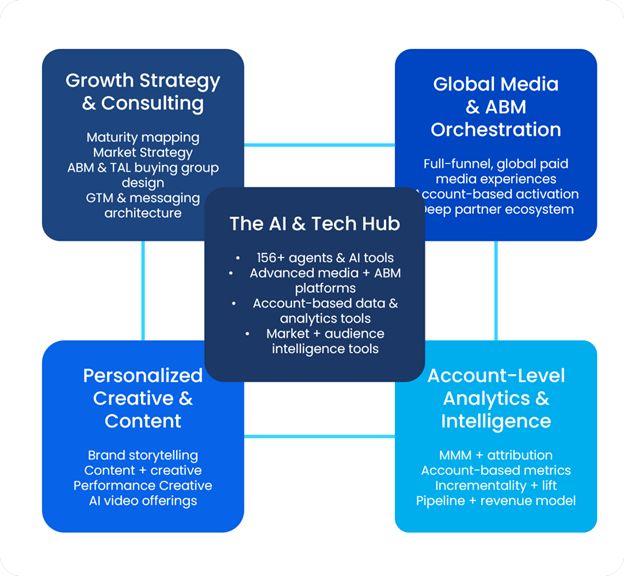
A brand-to-demand revenue system is a full-funnel growth model that connects early-stage brand influence with demand creation, account engagement, pipeline acceleration, and revenue measurement. Instead of treating brand and demand as separate motions, it aligns strategy, creative, content, media, ABM, data, and analytics around one goal: helping the right buying groups progress toward revenue. Just Global describes its growth approach as connecting creative, content, full-funnel media activation, and advanced analytics to deliver integrated B2B customer experiences.

Brand visibility matters more because B2B buyers are increasingly using AI-powered search and answer engines to understand categories, compare solutions, and shortlist vendors. If a brand is not clearly represented in AI-generated answers, it risks being left out of the consideration set before a sales conversation begins. Just Global’s AI Search perspective emphasizes structuring content, messaging, and digital presence so AI systems can understand and confidently reference a brand.

B2B marketers should measure account progression, buying-group engagement, pipeline lift, deal velocity, opportunity quality, media-influenced revenue, and closed-won business. MQL volume alone can overvalue low-intent leads and undervalue brand, content, and media touches that influence real buying decisions. A modern revenue system shifts measurement from activity reporting to revenue accountability.

ABM fits into a revenue system by focusing marketing, sales, and customer success on the accounts most likely to create long-term value. Instead of targeting individuals in isolation, ABM helps engage the full buying group with relevant messaging, content, and media based on account stage, intent, and business need. Just Global positions ABM as a way to align marketing, sales, and customer success to accelerate growth and turn key accounts into long-term revenue engines.

AI should be used to improve insight, speed, personalization, optimization, content relevance, and measurement across the entire B2B marketing system. The most valuable use of AI is not simply producing more content; it is identifying high-intent behavior, matching content to buyer needs, optimizing campaigns, scoring leads based on downstream value, and helping teams make smarter decisions faster. Just Global highlights AI’s role in accelerating insights, optimizing campaigns, and delivering stronger B2B marketing results.

B2B brands should look for a growth partner that can connect strategy, media, creative, content, ABM, analytics, AI, and global-local execution into one operating model. The right partner should understand revenue outcomes, not just campaign outputs. They should be able to unify account-level data, challenge outdated MQL-based measurement, support AI search visibility, and help global teams scale while staying locally relevant. Just Global’s capabilities emphasize empowering B2B marketing and sales leaders with data, technology, and AI to drive growth across sales, marketing, and customer success.

Blog

Keywords Are Dead. But Intent is Stronger than Ever.

Keyword control is over. Google Marketing Live 2026 confirmed AI Max is mandatory, DSAs are gone by September, and AI Mode now has a billion monthly users. The new battleground isn’t keywords — it’s the quality of your inputs. Here’s what B2B marketers need to know.


Blog

Are Marketing Agencies Dead in the AI Era?

Most marketing teams don’t have an AI problem. They have a workflow problem. This piece explains why agencies still matter in the AI era: not as tool operators, but as partners who help brands turn experimentation into clearer operations, better decisions, and healthier marketing teams.